NEW GENERATOR FOR Food Hunt APP: Food Hunt Free Coins and Power Ups CODES, Free everything! UNLOCKED!
The newest updates have added more reasons to pay attention to boosters. The September 2026 update introduced a new Gun Booster, alongside shop improvements and a new Super Cave mechanic. The exact behavior of these features may vary by update and platform, but the direction is clear: the developers want power-ups to feel more active and more central to the experience. A “Gun Booster” immediately suggests a more aggressive form of assistance, likely designed to clear or disrupt blocks rather than merely help with sorting. That can be exciting, but it also reinforces the sense that Food Hunt is gradually building more situations where the intended solution involves spending coins.
My main criticism is that Food Hunt sometimes confuses difficulty with scarcity. A good puzzle game makes you feel clever when you solve it. Food Hunt often does that, especially in its early and middle stages. But when a level becomes so constrained that the practical answer is “use a booster or lose,” the satisfaction shifts. You are no longer solving the puzzle; you are paying to bypass a bottleneck. Player reviews echo this concern, with some describing later stages as nearly impossible without power-ups and others arguing that the coin costs make the game feel designed to encourage spending.
The ads deepen that tension. Food Hunt includes advertisements after levels, and players frequently mention that even those who purchase an ad-free option may still encounter ads when claiming coin rewards or obtaining boosters. That is an important distinction. Removing interruptions from normal gameplay is not necessarily the same as removing the ad-based economy that feeds the booster system. If you want enough coins to use power-ups comfortably, the game may still ask you to watch promotional videos. For players who value uninterrupted sessions, that can undercut the relaxing promise of the game.
Still, I would not call Food Hunt predatory in the blunt, obvious sense. The core game is playable without spending money, and the puzzle itself has real charm. The issue is more subtle: the game’s generosity does not always match its difficulty. When every level pays the same, but the hardest levels demand the most resources, the player’s natural instinct is to save coins for emergencies. That creates a cautious style of play. You begin avoiding boosters not because you enjoy the challenge, but because you fear running out later. A resource system should encourage confident experimentation; Food Hunt’s economy can sometimes encourage anxiety instead.
The Food Pass illustrates this problem especially well. One player review calculated that reaching a 50-coin reward required beating six levels, even though a single completed level already grants 40 coins. If that assessment reflects the live game, the pass’s early rewards feel weak compared with ordinary play. The larger prize—reportedly 5,000 coins—requires a long grind, while the pass itself costs $9.99. For dedicated players, it may still have value, but the value proposition depends heavily on how many levels you complete and whether you actually need the coins for boosters.
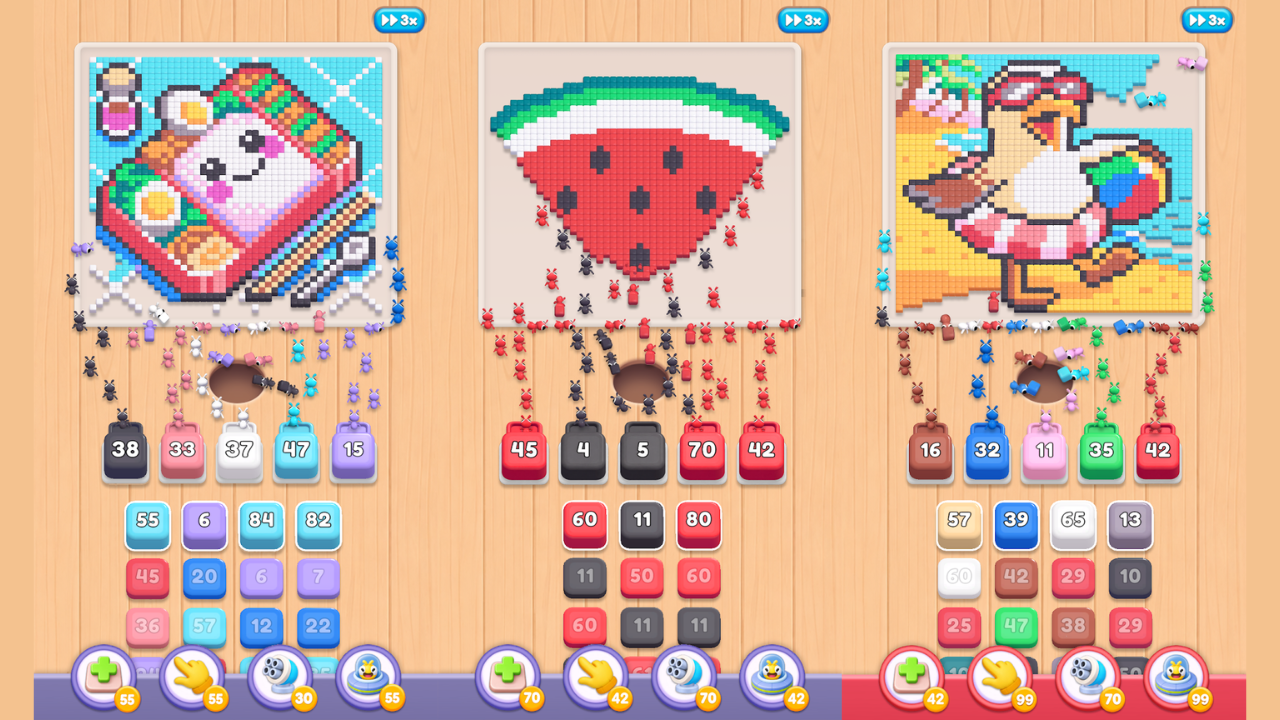
What saves Food Hunt from becoming merely another monetized puzzle app is its presentation. The pixel art is genuinely pleasant, and the decision to make the artwork the puzzle board gives the game a distinct identity. You are not sorting abstract gems into jars or matching generic candies. You are dismantling a tiny edible scene, one color layer at a time. That gives every level a small narrative arc: the image begins whole, becomes fragmented as the ants eat through it, and finally vanishes. It is a clever visual metaphor for completion.
The ants themselves help too. They are cute without being cloying, and their movement gives the game life. A color-sort puzzle could easily feel sterile, but Food Hunt makes the act of clearing blocks feel physical. The ants do not simply delete pixels; they swarm, bite, and consume. That personality matters in a game built around repetition. When the core action is enjoyable in itself, players are more willing to forgive the economy surrounding it.
For anyone considering downloading Food Hunt, my advice is to treat coins as a limited toolkit rather than a constant companion. Do not spend a booster just because a level looks inconvenient. First, pause and study the board. Identify which colors appear in the largest stacks, which colors are likely to create slot conflicts, and which moves will open the most space. Food Hunt rewards patience more than speed. Since there is no timer, there is no reason to tap impulsively. The players who get the most from the game are the ones who treat every move as part of a sequence rather than a reaction to whatever color looks most available.
Save power-ups for genuine dead ends, especially in later stages where a restart costs more time than the booster costs coins. If you are only a few moves from victory and a single booster will finish the board, that is usually a good investment. If you are early in a level and simply dislike the layout, restarting may be the better choice. The game does not always make that distinction obvious, but it becomes clearer once you understand how quickly coins can disappear.
It is also worth using free coin opportunities deliberately. If an ad grants enough coins to make a booster affordable, and you were going to take a break anyway, the exchange may be worthwhile. But do not let the promise of coins turn a five-minute puzzle session into a thirty-minute advertisement marathon. Food Hunt is at its best in short, focused bursts. The moment the reward-chasing becomes the main activity, the game loses the calm, tactile appeal that made it enjoyable in the first place.
There is also a case for playing without boosters for as long as possible. Not out of stubbornness, but because the early and mid-game boards are designed to teach you the logic of the system. Every time you solve a level without help, you learn something about color order, slot management, and board reading. That knowledge makes later power-ups more effective, because you will use them at the right moment rather than panicking and spending coins on the first sign of trouble. In that sense, coins are best used to extend your skill, not replace it.
Food Hunt’s broader design philosophy seems to be “relaxing until it is not.” The game markets itself as a no-timer, one-handed, stress-free puzzle, and much of that is true. There is no countdown breathing down your neck, and the visual style is warm and approachable. But the coin-and-booster system introduces a different kind of pressure: economic pressure. You may not be racing the clock, but you are constantly aware that a bad decision could cost you resources you cannot easily replace.
The developers have made some moves in the right direction. Recent update notes mention booster confirmation, improved shop experiences, better rewards, and more free-coin opportunities. Booster confirmation is particularly important because accidental taps can waste a scarce resource. Several players complained about accidentally activating power-ups with no way to undo them, so adding confirmation should reduce one of the most frustrating ways to lose coins. It is a small quality-of-life fix, but it shows that the developers are at least aware of how valuable these resources feel to players.
Food Hunt: Pixel Puzzle is a game of two experiences. The first is delightful: a colorful, low-pressure puzzle where ants eat pixel food and each completed board delivers a small burst of satisfaction. The second is more transactional: a coin economy where power-ups become increasingly necessary, ads become part of the resource loop, and difficult levels can make your balance feel fragile. The game is worth playing if you enjoy color-sort puzzles and can accept that its economy will occasionally ask for patience, ad views, or money.
For me, the coins and power-ups are both the game’s greatest convenience and its biggest flaw. They make Food Hunt more forgiving when a board turns hostile, and they can preserve the joy of a long puzzle run. But they also reveal the limits of the game’s “relaxing” identity. When a booster costs the equivalent of dozens of levels, every tap carries weight. Food Hunt is at its best when it lets you enjoy the feast without making you count every crumb. When it does that, it is one of the more charming casual puzzle games on mobile. When it does not, the ants are still cute—but the bill comes due one pixel at a time.